
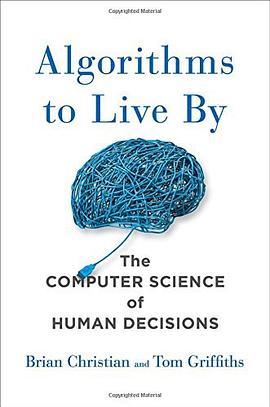

Algorithms to Live By
1 Optimal Stopping 9
When to Stop Looking
2 Explore/Exploit 31
The Latest vs. the Greatest
3 Sorting 59
Making Order
4 Caching 84
Forget About It
5 Scheduling 105
First Things First
6 Bayes’s Rule 128
Predicting the Future
7 Overfitting 149
When to Think Less
8 Relaxation 169
Let It Slide
9 Randomness 182
When to Leave It to Chance
10 Networking 205
How We Connect
11 Game Theory 229
The Minds of Others
Conclusion 256
Computational Kindness
Notes 263
Bibliography 315
Acknowledgments 335
Index 339
· · · · · · (收起)
具体描述
A fascinating exploration of how insights from computer algorithms can be applied to our everyday lives, helping to solve common decision-making problems and illuminate the workings of the human mind
All our lives are constrained by limited space and time, limits that give rise to a particular set of problems. What should we do, or leave undone, in a day or a lifetime? How much messiness should we accept? What balance of new activities and familiar favorites is the most fulfilling? These may seem like uniquely human quandaries, but they are not: computers, too, face the same constraints, so computer scientists have been grappling with their version of such issues for decades. And the solutions they've found have much to teach us.
In a dazzlingly interdisciplinary work, acclaimed author Brian Christian and cognitive scientist Tom Griffiths show how the algorithms used by computers can also untangle very human questions. They explain how to have better hunches and when to leave things to chance, how to deal with overwhelming choices and how best to connect with others. From finding a spouse to finding a parking spot, from organizing one's inbox to understanding the workings of memory, Algorithms to Live By transforms the wisdom of computer science into strategies for human living.
用户评价
看之前就比较担心是不是太trivial都是已经知道的东西,结果不幸料中。不过也好,打消了我写类似书的想法
评分##跟着小组分享重读了一遍
评分##听NPR的采访知道的这本书,印象是如何用算法帮助你找对象和收拾家。真读了以后感觉那些生活小窍门都是表层,这书的本质是用CS的角度去思考,从解决计算问题延伸到哲学。感触最深的是贝叶斯那章,人们都对prior有很好的直觉,但是这个直觉不停的在被追求吸引眼球的新闻扭曲。尤其现在这个一开电脑一摸手机,简直是一个人一个泡泡的世界里,protect your prior太艰辛了
评分##"A fascinating exploration of how insights from computer algorithms can be applied to our everyday lives, helping to solve common decision-making problems and illuminate the workings of the human mind",确实如此,希望我本科时就读过 (不过16年才出来呀...)
评分##指导生活的算法。恋爱的年龄与犹豫比例决策。时间保守与开放的选择。
评分##数学家教做人
评分##听NPR的采访知道的这本书,印象是如何用算法帮助你找对象和收拾家。真读了以后感觉那些生活小窍门都是表层,这书的本质是用CS的角度去思考,从解决计算问题延伸到哲学。感触最深的是贝叶斯那章,人们都对prior有很好的直觉,但是这个直觉不停的在被追求吸引眼球的新闻扭曲。尤其现在这个一开电脑一摸手机,简直是一个人一个泡泡的世界里,protect your prior太艰辛了
评分##关于算法的理性与感性,比如博弈论结尾这段儿:"The road to hell is paved with intractable recursions, bad equilibria, and information cascades, seek out games where honesty is the dominant strategy, then just be yourself."
评分##《指导生活的算法》 生活中的很多复杂决策,看上去没有规律可循,实际上是可以用算法来解决的。e.g.找对象用到的37%法则 很多时候我们会沉迷在细节里,看不清大方向,其实是犯了数学上的过度拟合错误。 时间问题本质上是个数学问题,用数学家的办法管理时间,才能活得更有效率。
相关图书









本站所有内容均为互联网搜索引擎提供的公开搜索信息,本站不存储任何数据与内容,任何内容与数据均与本站无关,如有需要请联系相关搜索引擎包括但不限于百度,google,bing,sogou 等
© 2026 book.teaonline.club All Rights Reserved. 图书大百科 版权所有