
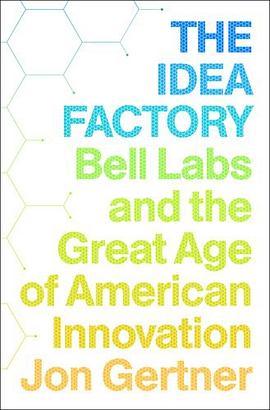

具體描述
A sweeping, atmospheric history of Bell Labs that highlights its unparalleled role as an incubator of innovation and birthplace of the century's most influential technologies. Bell Laboratories, which thrived from the 1920s to the 1980s, was the most innovative and productive institution of the twentieth century. Long before America's brightest scientific minds began migrating west to Silicon Valley, they flocked to this sylvan campus in the New Jersey suburbs built and funded by AT&T. At its peak, Bell Labs employed nearly fifteen thousand people, twelve hundred of whom had PhDs. Thirteen would go on to win Nobel prizes. It was a citadel of science and scholarship as well as a hotbed of creative thinking. It was, in effect, a factory of ideas whose workings have remained largely hidden until now. "New York Times Magazine" writer Jon Gertner unveils the unique magic of Bell Labs through the eyes and actions of its scientists. These ingenious, often eccentric men would become revolutionaries, and sometimes legends, whether for inventing radio astronomy in their spare time (and on the company's dime), riding unicycles through the corridors, or pioneering the principles that propel today's technology. In these pages, we learn how radar came to be, and lasers, transistors, satellites, mobile phones, and much more. Even more important, Gertner reveals the forces that set off this explosion of creativity. Bell Labs combined the best aspects of the academic and corporate worlds, hiring the brightest and usually the youngest minds, creating a culture and even an architecture that forced employees in different fields to work together, in virtually complete intellectual freedom, with little pressure to create moneymaking innovations. In Gertner's portrait, we come to understand why both researchers and business leaders look to Bell Labs as a model and long to incorporate its magic into their own work. Written with a novelist's gift for pacing and an ability to convey the thrill of innovation, "The Idea Factory" yields a revelatory take on the business of invention. What are the principles of innovation? How do new technology and new ideas begin? Are some environments more favorable than others? How should they be structured, and how should they be governed? Can strokes of genius be accelerated, replicated, standardized? The history of Bell Labs provides crucial answers that can and should be applied today by anyone who wants to understand where good ideas come from.
用戶評價
##2.monopoly X long term inno. forced to share patent freely bad for Bell good for industry 4 bell lab / start up?jury is still out 5.transistor: contact point vs. junction 6.satellite: buloon demo 7.optical fiber(Corning) vs. wave guide tube(Bell no ceramics expertise) 8."idea + plan + timing" innovation 9.telecom /computer converge?
評分##看看
評分##貝爾實驗室傳奇創新故事
評分##本書的撰寫方式和我想的不大一樣,結構上圍繞6個核心人物:Mervin Kelly, Jim Fisk, William Shockley, Claude Shannon, John Pierce, and William Baker,將貝爾實驗室本身的發展穿插瞭這些故事的中間,在講述這6個人的時候,還穿插瞭大量的技術創新理論點,感覺這個結構有點復雜
評分##2.monopoly X long term inno. forced to share patent freely bad for Bell good for industry 4 bell lab / start up?jury is still out 5.transistor: contact point vs. junction 6.satellite: buloon demo 7.optical fiber(Corning) vs. wave guide tube(Bell no ceramics expertise) 8."idea + plan + timing" innovation 9.telecom /computer converge?
評分##a good story about bell lab. btw, Shannon and Pierce is my idol~they not only have awesome idea but also charming personal character.
評分##2.monopoly X long term inno. forced to share patent freely bad for Bell good for industry 4 bell lab / start up?jury is still out 5.transistor: contact point vs. junction 6.satellite: buloon demo 7.optical fiber(Corning) vs. wave guide tube(Bell no ceramics expertise) 8."idea + plan + timing" innovation 9.telecom /computer converge?
評分##貝爾實驗室傳奇創新故事
評分##本書的撰寫方式和我想的不大一樣,結構上圍繞6個核心人物:Mervin Kelly, Jim Fisk, William Shockley, Claude Shannon, John Pierce, and William Baker,將貝爾實驗室本身的發展穿插瞭這些故事的中間,在講述這6個人的時候,還穿插瞭大量的技術創新理論點,感覺這個結構有點復雜
相關圖書



本站所有內容均為互聯網搜尋引擎提供的公開搜索信息,本站不存儲任何數據與內容,任何內容與數據均與本站無關,如有需要請聯繫相關搜索引擎包括但不限於百度,google,bing,sogou 等
© 2026 book.teaonline.club All Rights Reserved. 圖書大百科 版權所有