
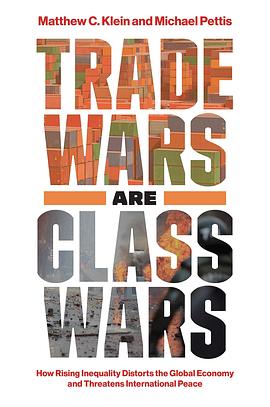

具体描述
Trade disputes are usually understood as conflicts between countries with competing national interests, but as Matthew C. Klein and Michael Pettis show, they are often the unexpected result of domestic political choices to serve the interests of the rich at the expense of workers and ordinary retirees. Klein and Pettis trace the origins of today’s trade wars to decisions made by politicians and business leaders in China, Europe, and the United States over the past thirty years. Across the world, the rich have prospered while workers can no longer afford to buy what they produce, have lost their jobs, or have been forced into higher levels of debt. In this thought‑provoking challenge to mainstream views, the authors provide a cohesive narrative that shows how the class wars of rising inequality are a threat to the global economy and international peace—and what we can do about it.
用户评价
##对中美的了解都加深了一点
评分##未必正确,但读一下有助于理解outsiders的思路
评分##和great rebalance一样的理论框架,可搭配看。没太涉及class war 和inequality,两者只是作为产能/储蓄剩余的起因被讨论。
评分##the distribution of purchasing power within a society affects its economic relations with the rest of the world.
评分##重温
评分##台版
评分##台版繁体,记忆点:第二章1820年开始的全球金融周期/危机梳理不错(逐利阶层的全球化运作,以及地方代表,势必表现以及勾稽政治和军事力量);重述霍布森观点,从贸易顺逆差追究到分配制度(世界大同可行性不高);以及简述全球贸易历史(盛极一时的避税安排以及国际贸易高融合下的全貌难解)
评分##the distribution of purchasing power within a society affects its economic relations with the rest of the world.
评分##对中美的了解都加深了一点
相关图书











本站所有内容均为互联网搜索引擎提供的公开搜索信息,本站不存储任何数据与内容,任何内容与数据均与本站无关,如有需要请联系相关搜索引擎包括但不限于百度,google,bing,sogou 等
© 2026 book.teaonline.club All Rights Reserved. 图书大百科 版权所有